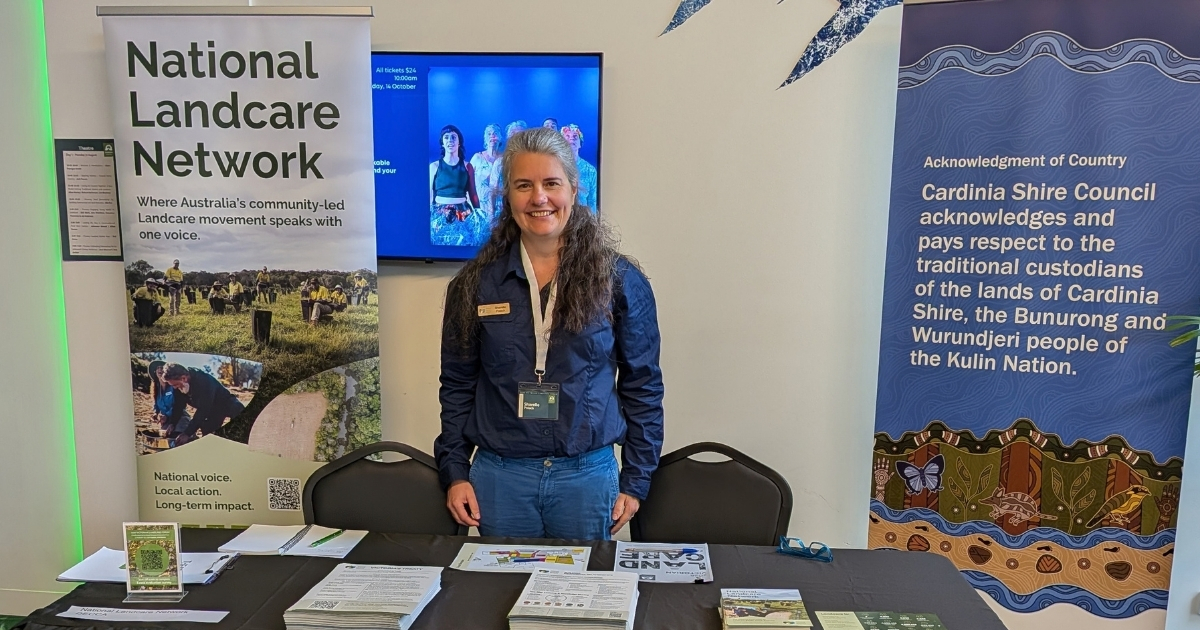
Sharelle Polack, NLN Landscapes Partnerships Manager
I had the pleasure of attending, presenting and facilitating during the 2026 Victorian Landcare Forum on Monday 31 August and Tuesday 1 September. A key topic I explored with attendees was diversifying investment in Landcare, drawing on lessons from Landcare Victoria’s successful New Futures program.
New Futures used Landscape Action Planning to bring Landcare communities and diverse partners together to develop 20‑year plans based on local priority projects. By looking beyond individual property boundaries and thinking at a landscape scale over longer timeframes, groups developed new ideas and fresh ways of approaching challenges. They also connected with a wider range of investors to discuss their plans and priority projects.
While Landcare will always need government and philanthropic grants, I highlighted that there are emerging opportunities to diversify funding, though each comes with challenges. For example, the New Futures program found that environmental markets (carbon or nature) were not economically viable for participating landholders. Complexity, existing land values, difficulty achieving scale and high upfront costs were key barriers. Impact investment and ethical superannuation also show promise but translating Landcare’s work into revenue streams at the scale investors require, is still a challenge.
The New Futures program revealed several ideas that communities can apply right now. These ideas not only broaden Landcare’s funding options, but they also create more pathways for young people and others in the community to become involved in Landcare.
- Diversify partnerships
Landcare often operates within an Environment and Agriculture funding bubble. We need to think more broadly about the value we provide—not just for agriculture and the environment, but also for wellbeing, intergenerational connection and community building, resilience in times of disaster and local economic development.
Across all three levels of government, there are potential funding and collaboration opportunities that are often overlooked. These include regional economic development, emergency management, climate resilience, health, employment, education and training, transport and roads. Beyond government, opportunities also exist with local businesses, water authorities, charities and educational institutions.
- Embrace the Circular Economy
A circular economy essentially operates the way our grandmothers and great‑grandmothers lived: reusing, repairing and repurposing resources to reduce waste.
Bega Circular Valley is Australia’s leading example. Their initiatives include:
- Reusing wastewater from the Bega Cheese Factory to irrigate dairy pastures
- Turning fish heads and offal into fertiliser
- Running a tool library and a timber‑refurbishment hub
- Using renewable energy at the local brewery, where spent grain feeds livestock and hops and yeast are composted to regenerate land
Their website is full of inspiration and case studies. The initiative has attracted a diverse mix of partners and funders including support from local, state and the federal government. It grows from strength to strength. Circular economy projects can help fund local initiatives while also advancing Landcare’s restoration goals.
- Explore Social Enterprise
Social enterprise offers another way for Landcare groups to fund and expand their work. There are grants available specifically for establishing social enterprises, along with helpful resources such as:
- Social Impact Hub
- Australian Centre for Rural Entrepreneurship
- Social Enterprise Australia
- Business Victoria
At the end of my presentation, I was asked why I hadn’t included renewable‑energy community benefit programs as a potential funding source for Landcare. These opportunities can certainly play a role, but decisions need to be made on a case‑by‑case basis. The suitability depends on the specific development, its potential impacts and the company or consortium involved. Several audience members shared examples of renewable‑energy projects in their communities that have worked well.
The broader message is that—whether the development involves renewable energy, data centres, mining, or something else—communities benefit from being prepared and clear about their priorities. Landscape Action Planning is a valuable tool for identifying what matters most for your community and landscapes, so you can engage proactively when new development proposals arise.